
During this busy start to the season, IndyCar has also revealed the track layout for the inaugural Washington, D.C. race, which is scheduled to happen on August 23. The event was added to the schedule in late-January, a little less than eight months from the announcement to the green flag. It took a little more than a month , but a course layout was made public prior to the Grand Prix of Arlington weekend.
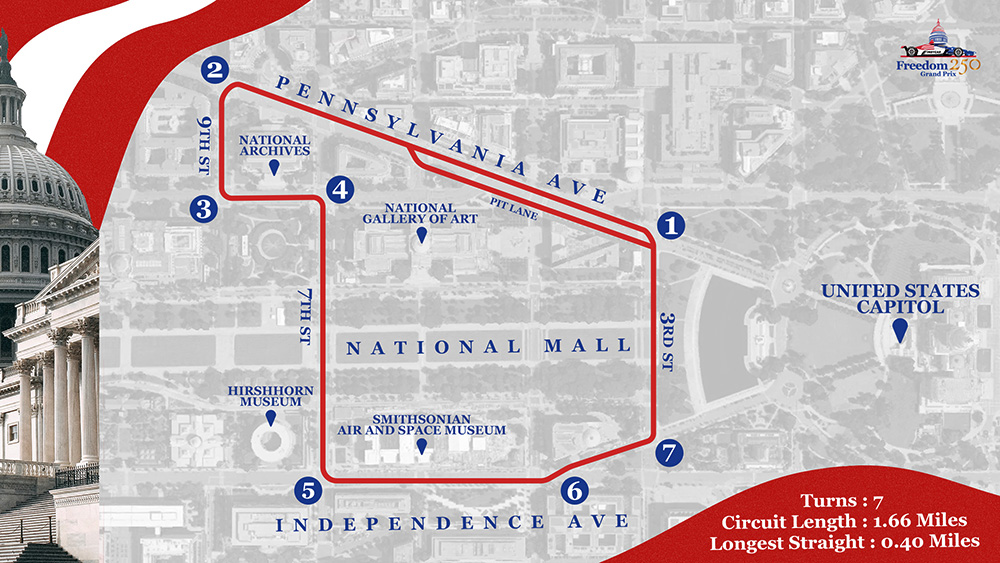
The track will use part of the National Mall with the start/finish line in front of the United States Capitol building before using Pennsylvania Avenue and a combination of streets to complete the 1.7-mile track.
It is not the most technical course. Of the seven turns, six are left-hand corners. It is a pretty condensed circuit. The longest straightaway is about a half-mile. It looks like a racetrack that was designed at the last minute and constricted to a very tight area. Some have expressed a lack of enthusiasm with the course design. We do not know how this track will run though, and just because it is not inspiring on paper does not mean it will not produce competitive racing.
We have seen enough street races in IndyCar that we can use the dimensions of the Washington, D.C. course and compare it to other tracks to set expectations.
For starters, let's use the longest straightaway. Running from turn one to turn two, this part of the track will also host the pit lane on the inside. It is list as 0.4 miles in length. For context, the main straightaway at St. Petersburg is about 0.4 miles in length before a tight right-hand corner. This straightaway is nearly a mirror image of the opening part of the St. Petersburg course. That part of St. Petersburg generates a good amount of passing, but that is coming from a slower hairpin corner and this straightaway in Washington will follow a less tight corner, which could help carry more speed and allow cars to get a better run into the corner.
After turn two, the course becomes pretty choppy. The run from turn two to turn three on 9th Street and the run from turn three to turn four on Constitution Avenue will each be a tenth of a mile in length. It is unlikely we will see much action there. A comparable section would be Toronto from turn four through turn six. It is a 90-degree left-hander between two straightaways that are each around a tenth of a mile in length. We saw passes in turn five of Toronto though not a crazy amount. This part of the Washington, D.C. course could see some action, though it is not likely.
The only saving grace could be if a car can hold the outside of turn two and turn three in Washington, D.C. it could form an advantage of having the inside of turn four. The cars will likely be going slow enough that it could stick. We saw drivers at Toronto be on the outside of turn three and have it turn into an advantage of being the inside of turn five. The difference though is turn four at Toronto was a slight left-hand corner and not a 90-degree left-hander like turn three in Washington, which should make it tougher to stick such an outside move.
The next portion of the course opens up, and the run from turn four to turn five, 7th Street, will be about 0.3 miles, not the longest run on the track, but not short either. At St. Petersburg, the straightaway from turn three to turn four is about a quarter-mile in length, and we see passes there, though they are less plentiful. They happen but we also know that part of St. Petersburg is not long enough that we constant passes there. Will the Washington, D.C. course benefit from that extra 0.05 miles heading to turn five? Maybe.
The next straightaway, Independence Avenue, is also about 0.3 miles in length from turns five to turn six, but the issue is turn six is barely a turn and it leads to what is barely a straightaway. Maryland Avenue is a blink from turn six to the final turn on the course, turn seven. It is less than a tenth of a mile in length.
Think of Long Beach and the section exiting the fountain to the right-handed turn four or that brief straightaway at St. Petersburg from turn eight to turn nine. The only difference is at Long Beach and St. Petersburg there are slow corners leading to those brief straightaways while at Washington, D.C. it will come after a proper straightaway. I imagine cars will be lifting and coasting onto Maryland Avenue before having to brake for the final corner of the circuit, the left-hander onto 3rd Street.
It could be an active section where if the inside is open, a driver would have the opportunity to dive into turn seven to get a spot. It is also a portion of the track that is currently occupied with a fair amount of road furniture. There is a complete traffic island in the middle of the street that likely will need to be cleared. In its current configuration, it is not practical to race on, and it would be purely single-file. Turn six would be an actual corner if the island is still there, but there is no way two cars could fit side-by-side. A pass would need to be completed before corner entry. Any accident there would cause a red flag for track blockage.
Outside of the island currently in the middle of turn six on Maryland Avenue, the only other street furniture that will need to be seriously addressed is a much smaller island in the middle of turn two. There are bollards and traffic lights that will need to be removed on Pennsylvania Avenue, which is likely a hassle and will require re-instillation after the race, but those will not require jackhammers and paving equipment. The work in turn two and turn six would require that.
Taking what we see and know from the Washington, D.C. course and comparing it to similar elements on other recent IndyCar street courses, what can we expect?
There is possibly one good passing area and another decent one, but outside of that, it could be tight and lead to less action.
Turn two and turn five are where we will likely see passes. Everyone thinks turn two is the one part of the course where drivers can make moves. Turn five will be another spot where it would not be surprising to see passes. We could see some type of passes attempted in turn six or turn seven depending on the road work that is done. The straightaway on Independence Avenue is long enough that someone could make an attempt, but the issue is how quick turn six will be and how tight will that section of the course be. If the island is cleared and paved over it could widen the track significantly enough that turn seven becomes a possible passing area. We must wait and see on that.
It is a track that is probably most similar to St. Petersburg, minus the longer section of the course with the kink between turns nine and ten. The shorter straightaways are something basically every street course has in common. The difference is the combination of corners and what leads to those straightaways.
Turn two through turn four will likely be slower and one of the slower sections of a track in IndyCar. The concern is that section of the course funneling everyone into a single-file line and it becoming more difficult to get a run to pass someone into turn five. If everyone is going 45 mph or slower for nearly a quarter-mile, the speed is not going to be great enough heading into turn five for a pass to be attempted. If you cannot make a pass there, you are likely not getting another chance at position until you are entering turn two again on the next lap.
It is March and IndyCar is just about to have its first off-weekend of the season. There is still a long time between now and then, and we would think over the next few months we will see progress made toward setting up this event. They aren't going to start tomorrow. If you think about most street courses, the construction doesn't start until about two months prior to the race. Long Beach's course is constructed in 50 days. Long Beach is also an event with 50 years of history and has developed a rhythm.
We shouldn't start wondering about progress and track construction until the start of June. With this race being thrown together so late and IndyCar's involved as it is essentially another series-promoted race, I don't think the ball will really get moving in Washington, D.C. until after Detroit, another series-promoted race.
Based on what we know, we can set some sort of expectations. We reserve the right to adjust those based on how things are developing as we get into summer and closer to the actual race weekend.
